
Blog
Cold Process Soap: What It Is, How It’s Made, and Why It Matters

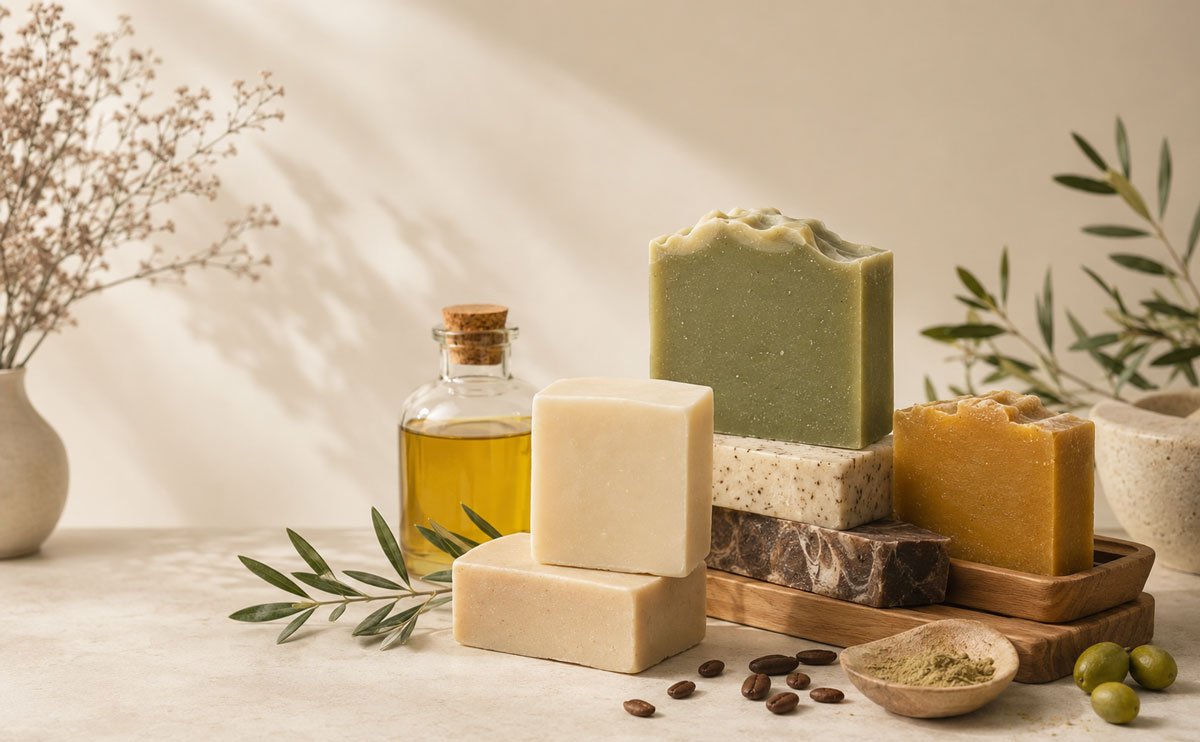
If you have been looking into handmade or natural soap, you have probably seen the term “cold process soap.”
It sounds a little technical, but the idea behind it is actually quite simple.
Cold process is a traditional way of making real soap. Oils are mixed with a carefully measured solution of sodium hydroxide (lye) and water. This starts a chemical reaction called saponification, which turns those ingredients into soap.
It is also the method we use to make our soaps at Leafsy.
So, what makes cold process soap different? And why does it take several weeks to make a bar that is ready to use?
Let’s go through it.
What Is Cold Process Soap?
At its simplest, cold process soap starts with three things: oils, water and sodium hydroxide.
Different oils can be used depending on the type of soap being made. Each oil brings something different to the final bar—some help with hardness, some contribute to lather, while others affect how the soap feels during use.
Once the oils and lye solution are combined in the correct amounts, saponification begins.
The mixture is then poured into a mold and allowed to set. After it becomes firm enough, the soap is removed from the mold, cut into individual bars and left to cure.
And this is where patience becomes important.
A cold process soap usually needs several weeks of curing before it is ready to use.
Wait... Does That Mean Soap Contains Lye?
This is probably one of the most common questions people have about handmade soap.
And it is a fair question.
Sodium hydroxide, commonly called lye, is used to make traditional bar soap. But it is important to understand that soapmaking involves a chemical reaction.
When a recipe is properly calculated, the sodium hydroxide reacts with the oils during saponification to form soap.
That is why making soap is not simply about mixing some natural oils together.
Measurements matter.
Formulation matters.
The amount of each oil matters.
We calculate our recipes carefully because soapmaking is chemistry, even when the ingredients themselves look simple.
So, What Makes Cold Process Soap Special?
For us, one of the best things about cold process soapmaking is the control it gives us over the recipe.
We can choose the oils and other ingredients ourselves instead of starting with a ready-made commercial soap base.
Depending on the formulation, cold process soaps can include ingredients such as:
- Neem
- Turmeric
- Activated Charcoal
- Natural Clays
- Botanical Powders
- Plant-Based Oils
- Essential Oils
But adding more ingredients does not automatically make a soap better.
The overall formulation needs to make sense.
A good soap is about balance—not about putting every trendy natural ingredient into one bar.
What About Glycerin?
Something interesting happens naturally while soap is being made: glycerin is produced during saponification.
Glycerin is a humectant, which means it can attract moisture.
In traditional cold process soap, this naturally produced glycerin remains in the finished bar.
This contributes to the characteristic feel that many people enjoy when using handmade soap.
Of course, that does not mean every handmade soap will work perfectly for every person.
Skin is personal. What feels great on one person's skin may not feel the same on someone else's.
That is why we think understanding the ingredients is more useful than simply choosing something because the label says “natural.”
Why We Make Soap in Small Batches
At Leafsy, we make our soaps in small batches.
There is a practical reason for that.
Small batches make it easier for us to pay attention to the formulation, measurements and consistency of each batch.
It is slower than mass production, but speed is not really the goal here.
Why Does Cold Process Soap Need Weeks to Cure?
This part surprises a lot of people.
You cannot make a cold process soap today and put it on the shelf tomorrow.
After the soap is removed from its mold and cut, the bars need time to cure.
During the curing period, water gradually evaporates from the soap. The bars become harder and generally last better during use.
So when you see a handmade soap bar, there is usually much more time behind it than the actual day it was mixed and poured.
For us, that waiting is simply part of making cold process soap properly.
Cold Process Soap vs Commercial Cleansing Bars
There is a common idea online that handmade soap is always “good” and commercial soap is always “bad.”
We do not think it is that simple.
Some products sold as soap are actually detergent-based cleansing bars made with synthetic surfactants. Traditional cold process soap is made through saponification.
They are different approaches to cleansing.
But being handmade does not automatically make a product good.
A badly formulated handmade soap is still badly formulated.
In the same way, something being manufactured commercially does not automatically make it harmful.
What is actually inside the product you are using?
Look at the ingredients. Understand what you are buying. Then decide whether it is right for you.
How to Choose a Handmade Soap
If you are buying handmade soap for the first time, start with the ingredient list.
A good product should tell you what is actually in the bar.
Do not rely only on words like “natural,” “organic,” “herbal” or “chemical-free.” Those words can sound impressive, but they do not tell you much by themselves.
Also think about what you want from the soap.
- Are you looking for a simple everyday bar?
- Are you interested in a soap made with neem?
- Would you prefer something containing charcoal?
- Are you looking for a different type of cleansing experience?
Different formulations serve different purposes.
And if you have particularly sensitive or problematic skin, it is always sensible to be more careful when introducing any new skincare product.
How We Approach Soapmaking at Leafsy
We started Leafsy with a fairly simple idea: make products carefully and be clear about what goes into them.
We do not want to tell someone that one bar of soap will magically transform their skin.
That is not how skincare works.
Instead, we focus on our ingredients and formulations.
Our soaps are made using the cold process method, in small batches, and the ingredients are clearly listed so you can see what you are actually using.
No mystery ingredient list.
No miracle story.
Just handmade soap made with thought and care.
Final Thoughts
Cold process soapmaking is not a quick process.
A batch may only take a relatively short time to mix and pour, but that is only one part of the story. The soap still needs to set, be cut and then spend weeks curing before it is ready.
Maybe that slower process is part of what we like about it.
It gives us control over what goes into each recipe and reminds us that good handmade products do not always need to be rushed.
If you are looking for handmade soap in Bangladesh, take a moment to look beyond the packaging.
Read the ingredients.
Learn a little about how the soap was made.
And choose what makes sense for your skin.
That is the approach we follow at Leafsy, too.
Discover Leafsy Handmade Soap
Explore our small-batch cold process soaps, made with carefully selected ingredients and transparent formulations.
Explore Leafsy Handmade Soaps